 Sunsir - Global OEM/ODM Kitchen Appliance Solutions
SEARCH
Search Store
Site Search
— 葡萄酒 | 威士忌 | 白兰地 | 啤酒 —
— 葡萄酒 | 威士忌 | 白兰地 | 啤酒 —
Blogs
Most home cooks treat dehydrators as simple “set it and forget it” boxes. However, after a decade in professional kitchens, I can tell you that not all boxes are created equal. Consequently, the difference between perfectly cured beef jerky and a batch of spoiled meat often comes down to the engineering standards of the dehydrator manufacturer.Freeze Dryer vs Dehydrator: How to Choose the Best Food Dehydrator
Whether you are a culinary enthusiast looking for a long-term appliance or a business owner scouting a food dehydrator supplier for private labeling, understanding the manufacturing source is critical. Cheaply made units suffer from poor thermal circulation, leading to “case hardening”—where food dries on the outside but retains moisture inside, creating a breeding ground for mold.
In this guide, we will strip away the marketing fluff and look at the technical specs that separate a top-tier food dehydrator manufacturer from the generic competition.
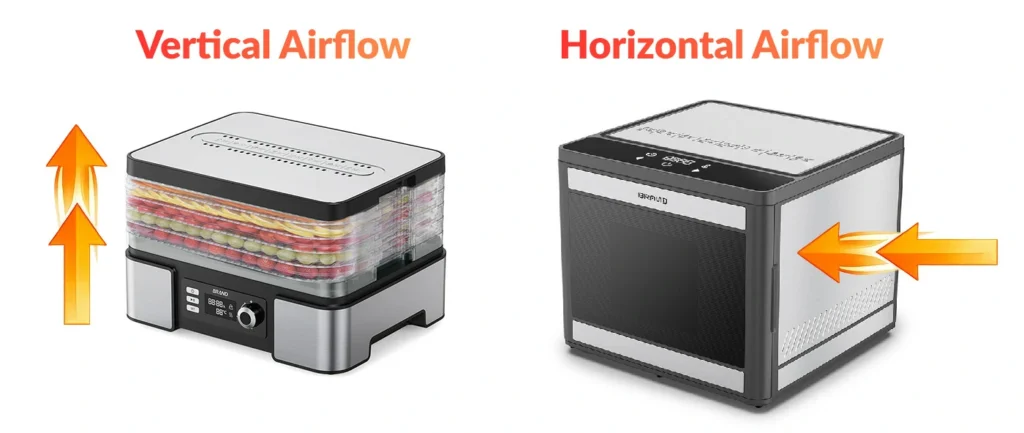
When evaluating a food dehydrator factory, the first engineering choice you must assess is airflow direction. This isn’t just a design preference; it dictates what you can successfully preserve.
Typically, entry-level manufacturers produce vertical flow models. Here, the fan and heating element are mounted at the bottom (or occasionally the top).
A premium dehydrator manufacturer will almost always prioritize horizontal airflow for their high-end lines. The fan is mounted in the rear, blowing air across all trays simultaneously like a convection oven.SG-J4007S Household Food Dehydrator Fruit Dryer Small Appliances Mechanical version
Pro-Tip: If a manufacturer claims their vertical unit doesn’t need rotation, they are likely over-promising. Physics is physics. Stick to horizontal models for meat and dense vegetables.
A best food dehydrator manufacturer distinguishes themselves through material choices. In lower-end factories, cost-cutting leads to the use of thermoplastics that may degrade over time under constant heat.
This is a technical term for the temperature fluctuation allowed by the controller.
When sourcing, you are generally looking at three categories of manufacturers. Understanding these will help you navigate the market price vs. quality trade-off.
Brands like Excalibur or Tribest are industry leaders. While some assembly may happen overseas, the engineering specifications and quality control (QC) are rigorous.
These are food dehydrator manufacturer, often in Asia, that design machines and allow brands to slap their logo on them.Exploring the Food Dehydrator Manufacturer, OEM, ODM, Private Lable, Custom Available
These are the sub-$50 units found in discount aisles.

If you are a business looking for a food dehydrator manufacturer for a private label, or just a consumer wanting the best, look for these trust signals:
Don’t just look at total watts (e.g., 600W vs 1000W). You must look at watts relative to capacity. A huge 20-tray commercial unit with only 600W will take days to dry fruit leather. Conversely, a compact unit with 1000W might scorch your herbs.
It seems minor, but a dehydrator manufacturer that uses a solid metal door forces you to open the unit to check progress. Every time you open the door, you lose heat and extend drying time. Always opt for glass or transparent viewing windows.
Digital isn’t always better. A cheap digital board is more prone to failure in a hot, humid kitchen environment than a rugged analog dial. Unless you are buying from a premium food dehydrator factory, a simple dial is often more durable.

Once you have selected your machine, follow these tips to extend its life, regardless of the food dehydrator supplier:
dehydrator manufacturer

A home vacuum sealer can be a game-changer for your kitchen, Here’s why you should consider one: Extend Shelf Life – Remove air to prevent spoilage & freezer burn (food stays fresh 3-5x longer!). Reduce Waste – ...
View details
Tired of chaotic mornings? The egg boiler is the kitchen hero you’ve been waiting for. This article explores how the Sunsir 3 egg boiler electric automatic can transform your rushed mornings, delivering perfectly cooked eggs with zero effort. Di...
View details
The Spring Festival atmosphere still lingers. Here at Sunsir, a new chapter has officially begun. Today, with great energy, our entire team has returned to work. We are happy to announce we are fully back to work after Chinese New Year 2026....
View details
Do you ever find yourself throwing away freezer-burnt meat, wilted greens, or stale snacks? Traditional food storage often lets us down, allowing air and moisture to creep in, causing spoilage and waste. What if you could easily add days, weeks, ...
View details English English
 Russian
 French
 German
 Spanish
 Italian
 Polish
 Dutch
Dutch Swedish
 Danish
 Finnish
 Norwegian
 Czech
Czech Hungarian
 Romanian